
The Master Guide to Buying Digital Advertising Space in 2026

Did you know that worldwide mobile advertising spending is projected to exceed $400 billion in 2026? This massive shift represents over 60% of all digital ad spend, yet many brands are still fighting for scraps on over-saturated social platforms. You’ve likely noticed that traditional digital advertising space is becoming harder to optimize as ad fatigue sets in and low-quality bot traffic inflates your costs. It’s exhausting to watch your budget disappear into generic networks that fail to reach the niche app enthusiasts you need.
We’re here to pull back the curtain on a more sophisticated strategy. You’ll learn how to secure high-intent placements at the source of app discovery, allowing you to bypass the noise and connect with an insider audience of early adopters. This guide breaks down how to gain transparent control over your placements and leverage APK discovery for superior ROI. We will walk through the transition from old-school tracking to privacy-first strategies that align your brand with user intent and real-world results.
Key Takeaways
- Move from generic “spray and pray” banners to context-aware digital advertising space that aligns your brand with specific user intent.
- Identify the hidden costs of programmatic networks and learn why direct-buy placements provide the transparency and control required for high-performance campaigns.
- Gain insights into the psychology of mobile app enthusiasts who use APK platforms, positioning your brand in front of high-intent early adopters.
- Follow a professional protocol to audit traffic sources and ensure your placements remain visible and effective for your target demographic.
- Explore how specialized hubs for software distribution allow you to bypass generic networks and reach an elite, software-focused audience.
The Evolution of Digital Advertising Space: Beyond Generic Banners
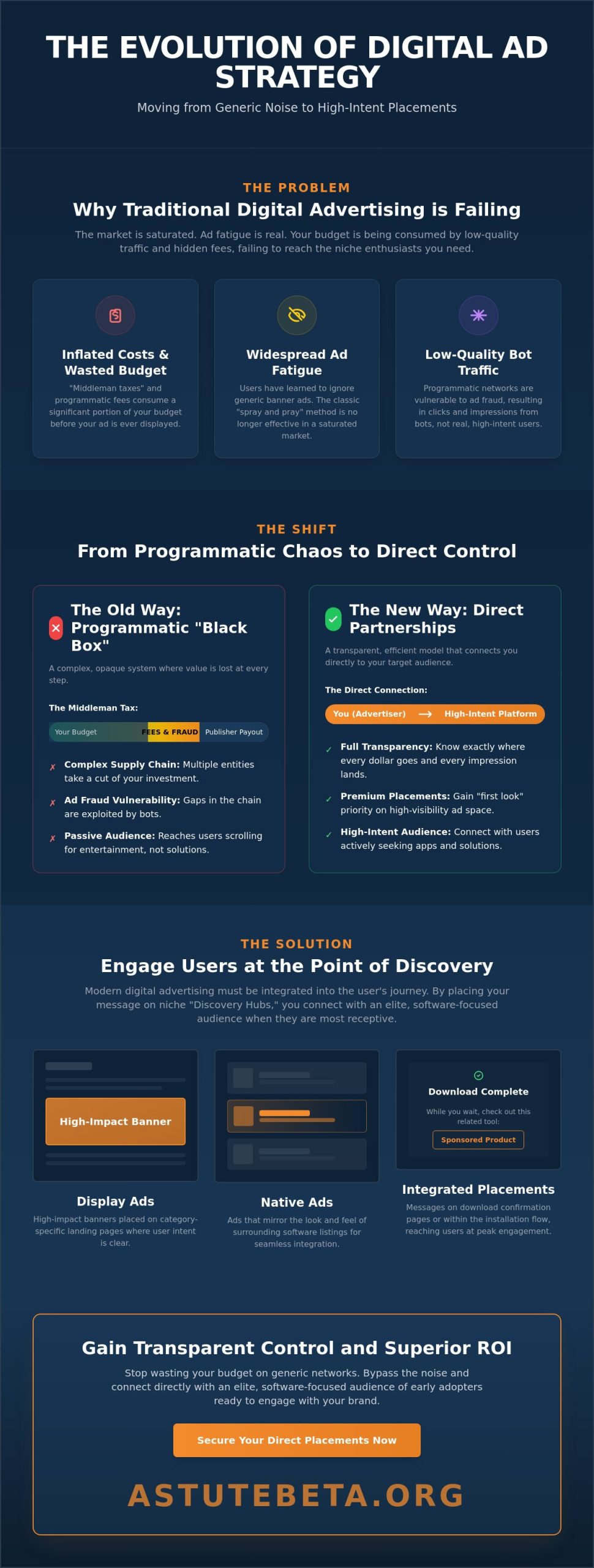
Digital advertising space isn’t just a pixel on a screen; it’s the strategic real estate where your brand’s message meets a user’s specific intent. Years ago, the game was simple. You bought as many impressions as possible and hoped for the best. This “spray and pray” method relied on massive reach, but the market in 2026 has outgrown such inefficiency. With global digital ad spend projected to hit $740 billion this year, the competition is fierce. Success now requires a move toward niche, high-authority platforms that offer context-aware placements. We call these “Discovery Hubs.” They represent a premium tier of inventory where users aren’t just scrolling; they’re actively seeking solutions.
The Shift from Broad Reach to Precise Intent
Why does massive social media reach often fail to convert? It usually happens because the user is in a passive state. They’re looking for entertainment, not a new tool or application. In a post-cookie environment, first-party data is the only currency that matters. When a user visits a platform to find a specific APK, they’ve already identified their need and are moving toward a solution. This makes them a “hot” lead. For a deeper online advertising overview, you can see how the industry has moved from mass broadcasting to this type of intent-based targeting. You’re no longer just buying eyeballs; you’re buying a moment of high-intent action where the user is already primed to engage.
Inventory Types: Display, Native, and Integrated
Standard 728×90 or 300×250 banners often fall victim to ad fatigue. Users have learned to ignore these zones entirely, a phenomenon that has only intensified as mobile usage dominates over 60% of the market. Modern digital advertising space must be more integrated to be effective. Consider these high-performance options:
- Display: High-impact banners placed on category-specific landing pages.
- Native: Ads that mirror the look and feel of the surrounding software listings.
- Integrated: Placements on download confirmation pages or within the installation flow itself.
Placing your message on a download page ensures your brand is seen at the peak of user engagement. It’s a professional, secure way to introduce your product when the user is already in “install mode.” This transition from generic interruptions to helpful integrations is what separates the industry leaders from the rest of the pack in 2026.
Decoding Ad Inventory: From Programmatic to Direct Placements
Programmatic bidding often feels like a black box. You set a budget, and complex algorithms hunt for impressions across a vast web of sites. While programmatic accounts for 91.5% of display spending in 2026, it’s frequently bogged down by a “middleman tax.” Every entity in the supply chain, from demand-side platforms to ad exchanges, takes a small cut of your investment. By the time your ad actually serves, a significant portion of your working media budget has vanished into fees. Serious brands are pivoting back to direct-buy digital advertising space because it offers a level of transparency that algorithms simply can’t match. Buying directly ensures your message isn’t buried on a low-quality sub-network alongside bot-driven traffic.
The Programmatic Supply Chain vs. Direct Partnerships
In a standard programmatic chain, your dollar passes through multiple hands before reaching a publisher. This complexity creates gaps where ad fraud can thrive. Direct partnerships eliminate these vulnerabilities by creating a straight line between the advertiser and the platform owner. When you deal directly with the source, you gain “first look” priority. This means your ads appear in premium, high-visibility slots that often never even reach the open auction. Following FTC guidelines for digital advertising is also much easier when you have total control over your placement. You don’t have to guess if your brand is appearing next to questionable content; you have the logs to prove exactly where every impression landed.
Understanding CPM, CPC, and CPI in 2026
Pricing models have become more specialized as the market matures. While CPM remains the baseline for comparing disparate inventory types, it’s rarely the final metric for success in the mobile sector. You might see a low CPC, but if those clicks don’t lead to active users, your budget is being wasted. For those focusing on digital advertising space within the app ecosystem, CPI (Cost Per Install) is the gold standard. It ties your financial risk directly to tangible growth. This model is particularly effective when you’re distributing an APK or launching a new utility. If you want to see how high-intent placements can lower your acquisition costs, you can view premium direct inventory options that cater specifically to software-focused audiences. This approach ensures your spend is optimized for conversion rather than just empty views.
Why Mobile App Enthusiasts are the Most Valuable Digital Audience
Passive scrolling is the enemy of conversion. When a user lands on an APK or beta server platform, they’ve already transitioned from a passive consumer to an active seeker. This psychological shift is what makes mobile app enthusiasts the most valuable audience in the digital ecosystem. They aren’t just looking for entertainment; they’re looking for utility, performance, and early access. By securing digital advertising space in these environments, you’re reaching users at the exact moment their intent is highest. These individuals are the “alpha” users who define the trends that eventually trickle down to the mass market.
Investing in this niche traffic often raises questions about scalability. While social media offers billions of views, those views are frequently diluted by bot traffic and ad fatigue. A tech-savvy audience provides a much higher lifetime value (LTV). One early adopter who integrates your tool into their workflow is worth more than a thousand generic impressions. Quality always outperforms quantity when your goal is long-term growth and high ROI. You’re building a foundation with users who understand the value of specialized software and are willing to commit to it.
The “Insider” Advantage: Targeting Early Adopters
Beta testers are a unique breed of user. They possess high engagement rates and aren’t afraid to provide vocal feedback or spend early on a product they trust. When you place your brand within a specialized hub for software testing, you benefit from a “halo effect” of exclusivity. Your brand becomes part of an elite circle. This creates a sense of belonging for the user. They feel like they’ve discovered something before the rest of the world. This feeling often leads to viral potential. These users don’t just use software; they share it, discuss it, and recommend it to their own communities.
Contextual Relevance: Matching the Ad to the Download
Why does a utility app ad perform so much better on an APK site than on a general news site? The answer lies in contextual relevance. If a user is currently downloading a mobile tool, their mind is already focused on software optimization. Your ad isn’t an interruption; it’s a relevant suggestion. This “intent match” is the secret to securing high-performance digital advertising space. When your ad solves a problem the user is currently addressing, the conversion lift is significant. You’re meeting them in their natural environment with a solution that feels like a natural next step in their journey. This alignment reduces friction and builds immediate trust.
A Professional Protocol for Purchasing High-Performance Ad Space
Securing premium digital advertising space isn’t a matter of luck; it’s the result of a disciplined buying protocol. Many advertisers make the mistake of treating all inventory as equal, but the pros know that high-intent placements require a technical audit before a single dollar is spent. You need to start by auditing the platform’s audience demographics and traffic sources. If you’re targeting mobile users in a specific region, a platform with 90% global traffic won’t serve your goals. You must also evaluate visibility. Placements “above the fold” are essential for immediate impact, while “below the fold” spots often require a significantly lower price point to justify the decreased viewability.
Auditing Traffic and Brand Safety
Don’t take a publisher’s word for their traffic volume. Use independent tools to verify their geography and engagement metrics. It’s vital to ask publishers about their specific bot-mitigation strategies. High-quality platforms use server-side filtering to ensure your ads are seen by humans, not scripts. You should also look at the “Ad-to-Content” ratio. If a site is cluttered with too many banners, users will experience “banner blindness,” and your engagement will plummet. A clean, software-focused environment maintains user trust and keeps your brand front and center. If you’re ready to put this protocol into action, you can secure premium advertising space on a platform that prioritizes high-intent mobile users.
Negotiating the Best Placements
Negotiation is where you turn a standard campaign into a high-ROI powerhouse. You must choose between “Run of Site” (ROS) and “Category Specific” placements. ROS is often cheaper, but it places your ads on any page, including low-traffic archives. For better results, negotiate for category-specific spots that align with your product. If you’re launching a major software update or a new APK, consider a “Takeover” spot. This allows you to own every available slot on a high-traffic page for a set period, creating a sense of total market dominance. Consider these points during your next negotiation:
- Fixed vs. Rotating: Fixed placements give you 100% share of voice, while rotating spots are shared with other brands.
- Technical Specs: Verify if the platform supports HTML5 or video assets early to avoid last-minute production delays.
- Reporting Cadence: Establish a weekly reporting schedule to ensure transparency and allow for real-time optimization.
Multi-month commitments are an excellent way to lower your effective CPM. By showing a willingness to partner long-term, you can often unlock “insider” rates that aren’t available to one-off buyers. This steady presence builds brand recognition among the elite mobile community and ensures your message remains top-of-mind for early adopters.
Scaling with Astute Beta: Direct Access to an Elite Mobile Audience
Astute Beta Server functions as a specialized hub where the gap between software developers and elite mobile users is finally bridged. This isn’t a generic content farm. It’s a focused ecosystem dedicated to APK distribution and exclusive beta server access. When you choose to purchase digital advertising space here, you aren’t just buying impressions. You’re securing a position in front of a high-volume, software-focused audience that actively seeks out new tools. Our “Streamlined Environment” philosophy ensures that your brand isn’t lost in a sea of clutter. We prioritize visibility and user experience, meaning your ads are seen and respected rather than ignored or blocked.
You’ve already learned the importance of auditing traffic and negotiating direct placements. Applying those principles at Astute Beta Server is simple because the platform is built for transparency. We pull back the curtain to show you exactly where your brand appears. This approach fosters a sense of trust and community. It elevates your campaign from a simple advertisement to a meaningful contribution to the mobile development cycle. By joining this elite group, you gain an “insider” advantage that traditional networks simply can’t replicate.
Why Astute Beta Server Outperforms Traditional Networks
Traditional networks often struggle with low-quality traffic and bot interference. Astute Beta Server outperforms these generic options by implementing a high-intent filter. Users visit this platform for a specific purpose: to download software or join a beta test. This creates a transactional mindset where the user is already prepared to engage with new mobile solutions. Whether they are looking for a utility tool or a new gaming experience, they are in “action mode.” Because the platform maintains a worldwide scope, partners can scale their campaigns across global markets while maintaining the precision of a niche placement. This global coverage allows for international growth without sacrificing the quality of the lead.
Available Ad Placements and Integration
We offer a variety of placements designed to fit different campaign goals. From high-impact banners on discovery pages to native integrations within the download flow, our options ensure your brand remains top-of-mind. Joining this elite group of advertisers is a straightforward, professional process. We value transparency and real-world results over complex programmatic bidding wars. You’ll work with a team that understands the mechanics of app distribution and the importance of brand safety. If you’re ready to move beyond generic networks and reach an audience of true early adopters, you can inquire about premium advertising space on Astute Beta Server today. This is your pathway to securing digital advertising space that delivers high ROI and meaningful engagement in the competitive mobile landscape of 2026.
Future-Proof Your Strategy with High-Intent Placements
The landscape of 2026 requires more than just a budget; it demands a strategic shift toward transparency and contextual relevance. You’ve seen how moving away from the “middleman tax” of programmatic networks and toward direct partnerships can protect your brand and boost your ROI. By focusing on mobile app enthusiasts at the source of discovery, you align your messaging with users who are already in a transactional mindset. This isn’t just about finding any digital advertising space; it’s about securing the right real estate where your brand can thrive among elite early adopters.
Astute Beta offers a streamlined, professional environment for brands ready to scale. As a high-volume APK distribution hub with a targeted mobile-centric user base, it provides the “insider” access needed to outperform generic networks. It’s time to take control of your placements and join a community that values real-world results and meaningful growth. Secure Your Premium Ad Placements on Astute Beta and start building a more resilient, high-performance marketing foundation today. Your path to mastery begins with a single, smart placement.
Frequently Asked Questions
What is the average cost of digital advertising space in 2026?
Current market data shows that PPC ads typically range from $0.01 to $1 per click, while LinkedIn averages around $5.26. These costs vary significantly based on your niche and the platform’s authority. When you evaluate digital advertising space, it’s vital to compare these industry averages against the intent of the audience. High-intent platforms might have different structures but often provide a lower cost-per-acquisition by reaching users ready to take action.
How do I know if an online ad space marketplace is legitimate?
A legitimate marketplace provides transparent reporting and direct communication with the publisher. You should look for platforms that allow you to audit traffic sources and geography before you commit your budget. If a provider hides behind complex programmatic layers or refuses to share their bot-mitigation strategies, it’s a red flag. Trustworthy partners prioritize brand safety and offer clear documentation of exactly where every impression is served.
Is direct-buy advertising better than using Google Ads?
Direct-buy advertising offers a level of placement priority and transparency that Google’s programmatic auctions often lack. While Google provides massive reach, direct partnerships eliminate the “middleman tax” and ensure your brand isn’t buried on low-quality sub-networks. For brands seeking an elite mobile audience, dealing directly with a specialized hub ensures your message reaches high-intent users without the unpredictability and hidden fees of an open auction.
What metrics should I track to measure the ROI of my ad space?
Focus on Cost Per Install (CPI) and Lifetime Value (LTV) to get an accurate picture of your campaign’s health. In the mobile sector, simple click-through rates are often misleading. You need to track conversion rates from the download page and the long-term retention of users who discover your software. These metrics tell you if your digital advertising space is driving genuine growth or just generating temporary traffic spikes.
How does advertising on an APK site differ from social media ads?
Advertising on an APK site captures users in a transactional mindset, whereas social media ads often interrupt a passive browsing experience. A user visiting a software hub is actively looking for a specific tool or utility, creating a natural intent match. This leads to higher engagement because your ad acts as a solution to their current search rather than appearing as a generic distraction in a social feed.
Can I target specific geographic regions when buying ad space?
Yes, you can target specific regions, though you must stay informed about evolving regulations like the 2026 geofencing restrictions in Oregon and Maryland. Most premium publishers use server-side data to ensure your ads serve only to users in your desired markets. This precision prevents budget waste on irrelevant traffic and helps you comply with local advertising laws across different global territories and jurisdictions.
What are the most effective ad sizes for mobile-centric audiences?
While standard 300×250 and 320×50 units are still common, native integrations and download-flow placements are the most effective formats in 2026. These formats reduce ad fatigue by blending naturally with the site’s functionality. Instead of relying on a rotating banner, look for integrated spots on installation confirmation pages. These placements catch the user’s attention at the peak of their engagement when they’re already focused on the software.
How do I verify that my ads are being shown to real users?
Verify your audience by requesting server-side logs and reviewing the publisher’s specific bot-mitigation protocols. Legitimate platforms use advanced filtering to remove non-human traffic before it ever reaches your reporting dashboard. Professional partners are always happy to pull back the curtain on their traffic quality. This transparency ensures that your investment is spent on reaching genuine mobile enthusiasts rather than being wasted on automated scripts.